Showing posts with label Sonoran Desert. Show all posts

Sunday, May 13, 2012

Alluring, but not Quite Enough

The pea flower blooms of one of our indicator legume trees, the Ironwood
We're short-timers here, at least so far as the summer goes.  Two weeks from today the house-minders will be in place and we'll be headed north on I-25 to Albuquerque for a quick overnight enroute to our summer abode in the Colorado Rocky Mountains.  The temp here just ticked over to 100.0 degrees this afternoon, though the mornings are still wonderful and you can open the house up at some point overnight to let in the cool night air and sounds of the howling coyotes.

Black-headed Grosbeak eyeing the bird bath (he did) from the creosote
The smothering yellow has faded considerably, being replaced by the more subtle mauve blossoms of the ironwood and desert willow trees.  It seems to be a heyday for birds, either residents or migrants, and we feel like we're being flirted with in hopes of keeping us here.  Tempting, but no -- and some of you, like the gorgeous fresh Black-headed Grosbeak who has visited us as we sit outside in the mornings and the brilliant male Summer Tanager that has flashed by, we'll see at the cabin.

Quail eggs in the petunias...
Others, like the Gambel Quail, we're trying to get our fill of as they are resident to this area.  Our faithful mother quail who sat so diligently on her eleven eggs in a large petunia filled pot in the busy barrio garden, hatched her brood during an exciting haboob (crazy wind storm) we had a few days ago.  They huddled in the pot, easily viewed from our kitchen window, all that afternoon and night but departed sometime the next morning a few hours after dawn.  This morning as we walked out the back gate to get a look at two coyotes passing through I startled some young quail chicks sending them scattering  They were about the right age for "ours" and I was glad the coyotes had cleared off by then.

We're doing our best to enjoy the last couple of weeks here in the Sonoran desert (we do love it, even when it's triple digits), but can't help dreaming of sweaters and wood-fires on chilly cabin mornings and wondering if the aspens will be leafed by the time we arrive or if we'll see the newly resident moose (!!!) around the cabin.  In the meanwhile we'll enjoy our Tucson friends, the early mornings, and our volunteer days at the Desert Museum before saying adios for the duration.
 
Tough love at this time of the year


Sunday, April 29, 2012

F**cked

Now that I have your attention.

Flocked.
This palo verde has dropped its sesame seed sized leaves and put on this sulfurous mantle.

If you are in the Sonoran desert now and not in a coma, yellow is an inescapable fact of life, and who'd want to escape this?!  As I sat down to make this post I had to laugh.  I checked my email first and had a message from a friend and fellow docent (whom I greatly admire) at the Arizona-Sonora Desert Museum announcing a new post on her wonderful desert blog In the Sonoran Sun.  Her blog post topic?  The Yellow Moment.  Carole couldn't be more right.  This is a moment we anticipate annually, but I somehow always forget just how YELLOW it is.  It is a bittersweet time; most of the yellow blossoms will soon disappear under the searing platinum sun of summer in the Sonoran desert.

Here are some images I took this morning on a walk around our garden.

A Gila Woodpecker breakfasting on the hummingbird nectar
Golden Columbines in the barrio garden
Desert marigold tangled in a barrel cactus
An eruption of Mexican sunflowers
The scent from this chocolate flower can induce a relapse in a chocoholic
The fruit from last year's barrel cactus flowers
Prickly pear bloom, lemon yellow on the aqua and lavender pads
Variegated agave...what big, and purple, teeth you have!
Palo brea blossoms

Sunday, April 22, 2012

Earth Day and An Oldie but A Goodie


Here in the Arizona Uplands region of the Sonoran desert, spring always comes early compared with most of the rest of the country.  We have five seasons, and spring is generally considered to be February through April, with the season of Foresummer Drought following in the months of May and June.  Foresummer Drought is exactly what it sounds like; a time preceding actual summer with virtually a non-existent chance of rain.  It is not broken until the summer monsoons (changing wind patterns) and their resultant deluges begin, historically around July 4th.

It seems we are throwing "historically" out the window these days.  Today we'll probably hit 105 degrees or more, a degree or two hotter than yesterday.  Historic normals for this time of the year are the mid to high 80's.  We'll get back to normal late in the week, but climate change is real, and will have real repercussions.  Saguaros started blooming in late March, nearly a month ahead of schedule, and before their primary pollinators -- Lesser Long-nose Bats by night and White-winged Doves by day -- arrived in force (only a few scouts had shown up) from their northward-bound trip from Mexico.  Most of our annual wildflowers have long since reverted to seed form, practicing the desert survival strategy of avoidance, skipping summer altogether while lurking in the soil waiting for the right conditions to germinate this fall.  Cactus of all sorts are coming into their own in a riot of color, and the palo verde trees are crowding us with their sulfurous yellow clouds of bloom.

On this 42nd Earth Day (I was an impressionable 19 for the first one), I'm finding myself being more willing to own up to what I've know all along -- what we humans do matters to the health of the planet -- and it's getting harder for all of us to ignore that.

A delicious vegan breakfast!
I cut my environmental teeth on Diet for a Small Planet, but have only recently begun to walk the walk, sometimes more tentatively than others, of its message.  Last October I switched to a plant-based, low on the food chain, vegan diet and followed it quite successfully, in fact joyfully, for over five months (and NEVER felt better).  A two week road trip's challenges derailed me a bit, as did a few other considerations like a husband who didn't want to be on-board 100% of the time and friends and family who didn't know quite what to do with these new constraints.  I've added seafood, sustainably harvested per the Seafood Watch green light list, a couple of times a week, and also eat a few organic, cage-free (not ideal, I know) eggs as well.  This eases up the meal planning at home, making for better marital harmony, and gives us more options for going out, entertaining, or being entertained.  And yet, I feel the pull of a pure vegan diet still, and its unexpected benefit of knowing each day that no animal died or suffered to give me food.  I always knew if I really thought about it, faced the reality of factory farming from the misery of the animals involved to the damage to our planet and the whole unarguable unsustainability of it, I'd have to modify my behavior, and I have.  Some tweaking is still pending, but I know these changes of mine are making a difference.  I'm a better citizen of Planet Earth today than I ever have been, and hope to keep improving.

Today, in honor of Earth Day, we'll watch Al Gore's An Inconvenient Truth, not start our car, not eat meat, and go easy on the A/C.  One thing this dry desert heat is good for is clothes drying, and our sheets and the tablecloth and napkins from a dinner party we had last night (wild-caught Alaskan salmon) are outside instead of burning up energy in the dryer.  Here's an old post, but one I love, about drying clothes outside.

Happy Earth Day...


There’s something so wonderfully elemental and sensible about drying laundry in the fresh air of the out of doors. Here in the desert with its bountiful sunshine and low humidity, hanging wash outside is not only intuitive, but a pleasant and satisfying task which falls somewhere between a chore and an art form on the housework continuum. For many it is reminiscent of a time when life was simpler, if only made so by the passage of time itself.

Stuffing wet laundry into a machine that is noisy, heat producing, and a squanderer of a non-renewable energy source may be quick and easy, but it hijacks an opportunity to be One with Nature in a delightfully parsimonious and practical way: peeling all those sodden pounds of damp cloth off the inside of the washing machine basket, the outside layers dimpled from the spin cycle’s effort to strain them through the tub’s drain holes; plopping them in a laundry basket and ferrying them outside to endless blue skies and searing sunlight; feeling them instantly begin to give up moisture to the bone dry air.

The clean scent of the laundry soap mingles with the sharp smell of the desert vegetation and dry gravelly soils. My skin appreciates the slight rise in humidity in the immediate vicinity as I begin hanging the laundry. It gets me outdoors for a brief time in a climate that can be a challenge in co-existence during the daylight hours for much of the year.

For many of us, our home owner associations, in their infinite wisdom, have prohibited the traditional laundry line. In this day and age to discourage the almost effortless accomplishment of an unavoidable chore through the use of a limitless and non-polluting energy source can only be regarded as a patent crime against nature. The horror of being exposed to our neighbors’ sheets and boxer shorts is deemed a hideous affront to our sensibilities, instead of some lively and temporary yard art billowing and snapping in the desert winds.

Not to be deterred, I visited our handy hardware store and picked up a collapsible wooden drying rack. Occupying a space of about three square feet of the back porch when in use and extending to chest level, I can strategically arrange a full washer of laundry on this contraption, enjoying the accomplishment of a simple challenge well met. In little more time than it takes to cram my laundry into the gaping maw of my dryer, the damp laundry is efficiently hung on the rack’s dozen or so rungs. Before the last piece is draped, the first is showing the effects of our miniscule humidity, already feeling slightly dry to the touch. Depending on the contents of the load – heavy towels and jeans obviously are slower to relinquish all their moisture than pillow cases and unmentionables – the abundant breeze driven hot air does its job with amazing efficiency, quietly taking advantage of a free and inexhaustible energy source.

Then there’s the bonus of the finished product. Aside from blowing a cosmic raspberry at my HOA, I love the feel and smell of laundry dried outside. Removing the items from the rack, they have an agreeable stiffness, a gentle rigidity. Towels have a pleasurable roughness when first put to use after a shower, doing their job with astonishing effectiveness, and stimulating the skin in the bargain. Cloth napkins and dish towels dry to a pleasant smoothness and are not only satisfying to fold and store, but when retrieved from their drawers are a reminder of having gotten a nice assist from Mother Nature. Perhaps the greatest gratification comes from bed sheets hung outside, smelling of sunshine and dry sage and childhood, their solid smoothness a pleasure to slide into at night. Who could help but sleep better in sheets cloistering remnants of sunbeams shot across 93 million miles of our solar system, convincingly coloring dreams with the certainty of our oneness with the universe?


Sunday, January 8, 2012

On Stewardship and Petunias

The Sonoran desert is a unique environment.  Many think of it as a place filled with things that are too-tough-to-die, a place with incredibly hardy flora and fauna -- wouldn't it have to be? -- and that there's little we could do to impact it. Nothing could be further from the truth.  Every native plant and animal is exactly where it has to be and this challenging environment is exactly what it needs.  If it rained more most of the life in this area of the Sonoran desert, the Arizona Uplands region, would be replaced by other vegetation and critters.
Home, sweet home

Well, except for humans.  We like to move into an area and turn it into our own personal idea of paradise, regardless of how it conflicts with the reality of a place.  It could be that we want our yards to look like they did back on the east coast with manicured lawns, rose bushes, and pest-free vegetable gardens.  Maybe our motivation is our recreation, like golf courses.  Humans seem to want what they want regardless of where they are, and so long as they can afford it, the reality of the environment in which they find themselves, fast disappearing resources and the needs of the native plants and animals fall off their radar.

Worth the cost?
Today we're saying goodbye to an old friend that I've spent a lot of time appreciating from my kitchen window and across my neighbor's fence.  The arms are being amputated one by one.  The body will be sectioned and removed in manageable hunks.  It's probably older than my grandmother's great-grandmother's great-grandmother, and should have lived until my daughter was a much older woman than myself.    In a few hours this stately saguaro, icon of the Sonoran desert, will be gone, apparent victim, in this climate, of the excessive amount of irrigation water required to keep the petunias at its base alive...petunias the appropriate color in the appropriate spot for feng shui garden in one of the most beautiful deserts on the planet.  In a climate where the plants are so good at storing and managing their resources (a hydrated saguaro is about 90% water), too much of what we like to think of as a good thing will kill a plant that is much easier on, and infinitely more critical to, this environment than we humans are.

Symbiotic relationship between the White-winged Dove and the saguaro...
food and a nesting site for pollination services rendered
Phyrrhuloxia at the feast
And so much more than this huge multi-armed saguaro will be lost.  There were probably close to 100 nest cavities in its flesh, providing wonderful safe temperature-regulated places for our desert birds to raise their young.  Gila Woodpeckers and Gilded Flickers excavated every one of those holes, but they were eventually occupied by many different birds as well, from Screech Owls and Pygmy Owls, Purple Martins, Ash-throated Flycatchers and Brown-crested Flycatchers, House Sparrows, and American Kestrels.  Many other birds, from doves to hawks, build nests in the crook of the saguaro's arms.

We felt so lucky to have such a magnificent "bird condo" so close to our yard and loved being part of the extended habitat (birds only care about fences for sitting on).  It is doubtful that our yard will any longer be the flight training ground of the Gila Woodpeckers youngsters, being called between our two younger, and cavity-less, saguaros by their diligent parents.  The screech owl that flew from that saguaro to our mesquite like clockwork every evening just minutes after the sun set behind the Tucson Mountains, coughing up a pellet of indigestibles from last night's hunt, pooping, and having a rouse to realign his feathers before silently flying off in the darkening evening to find dinner will be very missed.  We used to say that he lived next door and we were the outhouse.    

Nectar beyond the pollen is the lure
Of course it's not just about shelter.  That saguaro, with its many arms, bloomed magnificently and with regularity each spring, providing desperately needed nectar in the dryest part of the year for any bird or animal who could get to the blossoms, most importantly bats by night and White-winged Doves by day.  If these primary pollinators were successful, large juicy fruits would ripen a month later, once again providing sustenance to all animals, including humans, who could reach them.  Each fruit, filled with an average of 2,000 seeds, would have these chances at procreation scattered by the birds and mammals that ate them.  Of the four and a half million seeds the average saguaro will produce in its lifetime, it will be lucky to reproduce itself once or twice, though the seeds will not be wasted, but eaten before or after germinating by innumerable insects and animals.

A sad and premature end
Even after falling a saguaro can bloom for another year or two, relying on its store of water and its continued ability to produce energy through photosynthesis.  When the inevitable happens, these huge rotting plants provide food and shelter for millions of insects and many mammals, and return it's nutrients back to the environment.  Except, of course, when they are carted off to the landfill, the sad and wasteful fate of our neighboring saguaro.

I am more aligned with the Native American notion that we don't really "own" land, but are simply temporary stewards of it.  Unfortunately, I have little faith that we humans will recognize what we have before it is gone.  I'll take a saguaro over petunias any day.  And the senior saguaro next door will be greatly missed, though most importantly, perhaps least of all by me.

Goodbye, Old Friend


Monday, December 12, 2011

Back and Gone Again


Old sign in South Tucson
I'm not usually highly distractible, but I must say that the last two and a half years of planning, building, and settling into a summer cabin in the Colorado Rockies certainly has tested me.  It was a great project, and as much as I love the Sonoran desert, a great place to escape the worst of the heat.  Now that the cabin is completed and we've settled in and spent four months in it over the summer, I'd like to think I'm back to my favorite place on earth and ready to give it my full attention, but we are about to head back north to spend Christmas and New Years at the cabin.  One of my resolutions for the coming year is to be wherever I am at the moment FULLY, but for now I wanted to take a little walk down memory lane.

We recently replaced an aged and expiring computer.  When they transferred over our data all my pictures from years ago, prior to my beginning this blog, became wonderfully accessible.  I wanted to share a few of them with you.  They are all reasons I love Tucson and the Sonoran desert.

The wonderful old Barrio Viejo market turned B&B where I used to stay
Some of my Moon Take Night Make Day hikers and part of the
reason I have been a volunteer ranger with Saguaro National Park
for almost ten years
A Virgin of Guadaloupe shrine in Barrio Hollywood
Ancient pictographs along a favorite trail
The screechless Western Screech Owl, a frequent visitor to our yard
The saguaro cactus, icon of the Sonoran desert
A not atypical sunset out our back door

How Christmas looks when we're in Tucson
These are just a few of the reasons I love Tucson, a place I have lived for ten years this month.  It has brought me many good things, including my loving husband, and is my chosen place on Earth.  It is my spiritual center and my home.

I hope you have a wonderful Christmas and terrific New Year, surrounded by those that mean the most to you and in a place that you love.

Saturday, April 9, 2011

Rejoice


In the kitchen happily looking out through the rain glazed window to the barrio garden.

A rare, and cold (in the 40's at 10 Am in mid-April with several 90+ days behind us), rain.  But oh-so-welcome.  One last day for books and hot tea and using the oven for dinner tonight, but the rain is the best part.

Sunday, April 3, 2011

Sunday Morning in Spring


Our favorite mesquite has leafed out this past week,
returning shade to the barrio garden

The weather has been unseasonably warm this weekend -- yesterday it was 95, today a little cooler.  Moving on towards noon it might make you retreat to a cool house, open all night and closed up early to keep from having to turn on the A/C (something we resist as long as possible).  But it is finally spring after the hardest, most damaging winter we've experienced here in Tucson, and it is so wonderful to see things flowering, leafing out, and taking off.

With warmer weather comes the return of outdoor eating.  The back porch is the morning destination of choice with coffee, binoculars, camera, and bird books in hand.  We hold court there for a couple of hours, watching the bird circus, having breakfast, taking pictures, and generally congratulating ourselves for living in the gorgeous Sonoran Desert.

Some of our breakfast companions:

Me and my shadow

Ocotillos make the best perches for birders ever!

This Abert's towhee sang to us during breakfast

After a while we decided to get a few things done, and took a tour of the yard, checking for signs of life in plants badly damaged by the Big February Freeze.  Most things survived (a moment of silence for the galloping cactus please) and some are clearly thriving.  We won't be throwing in the gardening towel any time soon, though we might fine tune our native plants to those that can take temps in the teens and still bounce back.

This hedgehog cactus came through the chill just fine

Cactus wren nest, extra padding

I had gotten a new bottle of meds for my dog with a huge wad of cotton under the cap (why on earth do they do that?).  Rather than throw it in the trash I pulled it apart and took it out to the garden last week, hanging bits on several of the plants around the yard.  Sure enough, it was salvaged by a cactus wren to use in at least one of his several nests in our chain fruit cholla cactus just outside the garden wall.  Maybe now he'll quit stealing stuffing from one of my outdoor pillows!

Happy Sunday!

Saturday, April 2, 2011

Youngsters

Momma dove, still sitting pretty in her "resort" nursery

We're not using the front door these days.  The front courtyard is mostly off limits due to the fearless dove that insisted on laying her eggs amongst the dove-deterrent chopsticks and balls of foil.  Any mother that determined deserves every chance to fledge her two chicks.  Here they are about six days after hatching.


There is still much that could go awry -- failure to thrive, a hungry snake or roadrunner -- but I'll keep you posted.

Tuesday, March 15, 2011

Lovey Dovey

It's spring again, at least in the Sonoran Desert (we do jump the gun a bit), and love is in the air.  And on the ground, and on our rafters, and in our flower pots -- despite our best efforts.

Who's keeping an eye on who?

Don't get me wrong.  I'm all for love.  All the time.  It's just that when it comes to our mourning doves it's so comic and so tragic so often.

They are not the first to get into the reproduction act, not by a long shot.  The diminutive Costa's hummingbirds laid eggs weeks ago.  But the mourning doves are so clumsy and obvious about it.

While my head was turned...
First we are treated to the males humping along behind a female, any female, multiple females, in a usually vain attempt at mating.  Even when successful it is over in the blink of an eye -- the females almost don't seem to notice and barely pause in their hunt for food.  But then the paltry excuse for nest building begins...a few twigs scattered on a rafter or in a plant pot, or heaven help us, in a tree or a cactus; the merest excuse of a nest.  Last year's attempt on our sloping metal porch light cover met with a sad disaster shortly before the eggs were set to hatch.  When it comes to nest building, mourning doves are neither members of the Craftsman's Guild nor the Brain Trust.

There's a favorite nesting spot in a raised planter immediately outside our front door.  When I first spotted the tell-tale pile of twigs a few days ago I cleaned them up and inserted five chopsticks and added two balls of aluminum foil as dove deterrents to the six inch pot already containing a petunia.  Foiled again (pardon the pun), as when I next looked a dove was happily esconsed between the chopsticks, leaning on the peturnia, and gazing at her fractured reflection in the aluminum foil, all while keeping the two eggs she'd almost instantly laid warm.  We'll be using the garage door and backyard gate for the foreseeable future while mama dove hatches and raises her chicks.

Maybe it's the ambiance...
Mourning doves really are lovely birds, but as with anything there's an overabundance of, it's value decreases, at least to us.  But as my husband reminded me, without a lot of doves, we wouldn't have as many raptors.  So true.
Cooper's Hawk in search of dove

Thursday, July 1, 2010

Sanctuary and Answered Prayers

Shortly after the official start of summer the Sonoran desert is well into its infamous heat, but the notorious dry heat is giving way to a steamier version.   When the weather pattern shifts, usually around the 4th of July, our desiccatingly low to nonexistent humidity gives way to an inflow of tropical moisture, bringing the novelty of clouds, and we wait anxiously for the first rain in months.

We like to help out our tough desert birds by providing fresh water, native food sources though habitat gardening (and the occasional handful of bird seed), shelter, and places to raise their young.  Our efforts are rewarded by the constant presence of some of the most fascinating and adaptive birds in the world.  In the middle of our hottest season we are seeing lots of fledgling birds -- slightly smaller than their parents, frequently seen harassing  them with begging behavior, and not quite as expert in the flying department.  We've had juvenile doves, cactus wrens, thrashers, gila woodpeckers, finches, and even a young pyrrhuloxia seeking the shade of the back porch.


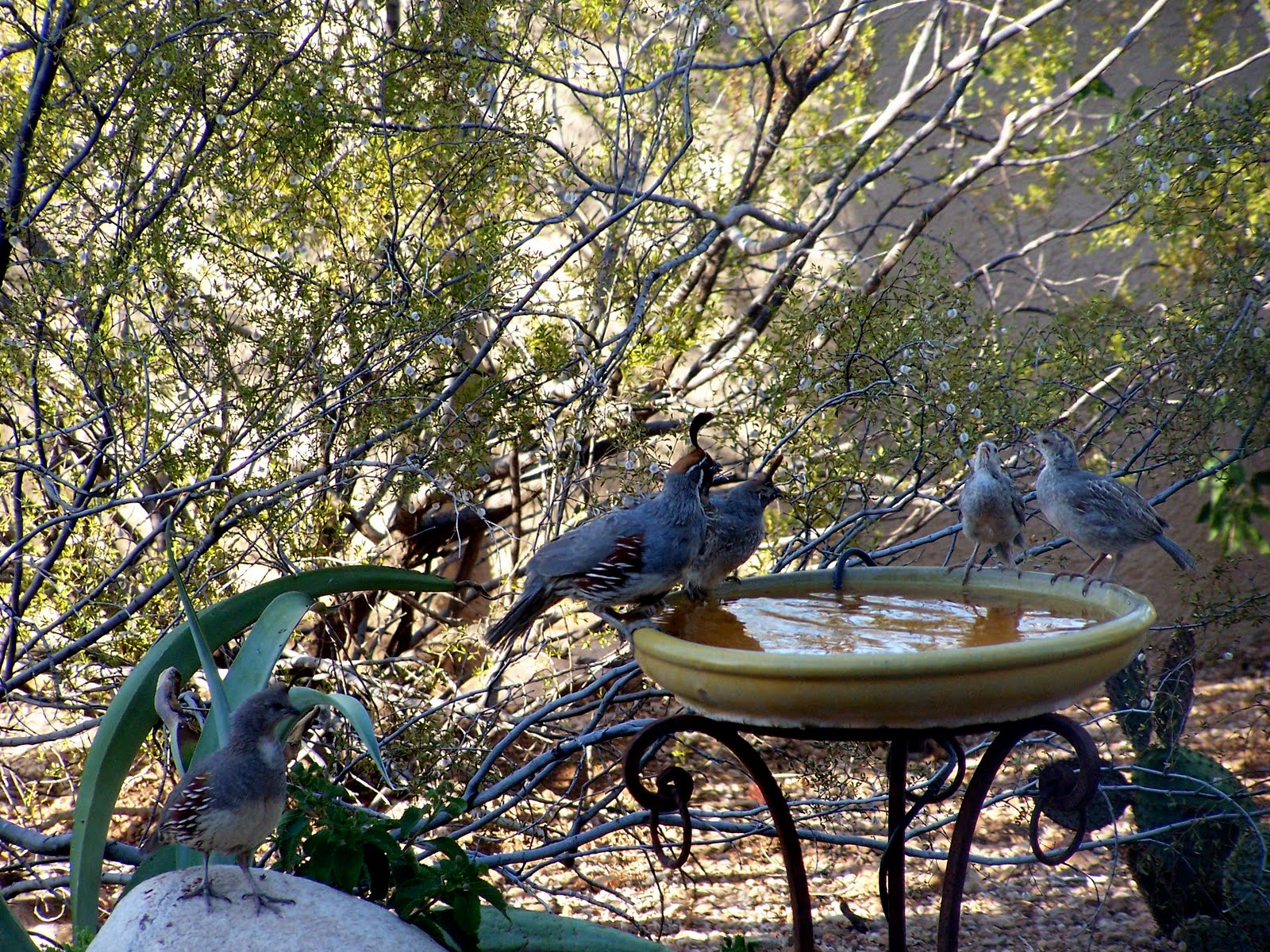
While desert birds have strategies to deal with the long months without rain in a land of little standing ground water, an easy source of water for drinking and bathing is much appreciated.  This early clutch of Gambel quail are being shown the ropes by their parents, visiting the bird bath for a quick early morning drink.

While some quail families are just finishing up their parental duties with their fledglings, others are just beginning, or beginning again.  This clutch of ten eggs is usually hidden by a dedicated female quail, and is due to hatch any time now.  Seeing a string of puffball quail chicks obediently following their mother while papa quail stands guard duty on the garden wall is one of our favorite desert experiences.  A year with abundant (for us) rainfall insures the resources needed to raise more than one family a year, and we are witnessing a banner year for wildlife.

Late this afternoon, bolstered by adequate humidity and triple digit heat, we had our first brief rain of the monsoon.  There is nothing like the first rain after months without, months of searing heat.  The first drops steam off the hot flagstone, and the fragrance of creosote instantly fills the air.  The cool rain on hot parched skin is an exquisite study in contrasts.  And the breaking of the long absence of life-sustaining rain is an answered prayer.