Showing posts with label Tucson. Show all posts

Sunday, May 13, 2012

Alluring, but not Quite Enough

The pea flower blooms of one of our indicator legume trees, the Ironwood
We're short-timers here, at least so far as the summer goes.  Two weeks from today the house-minders will be in place and we'll be headed north on I-25 to Albuquerque for a quick overnight enroute to our summer abode in the Colorado Rocky Mountains.  The temp here just ticked over to 100.0 degrees this afternoon, though the mornings are still wonderful and you can open the house up at some point overnight to let in the cool night air and sounds of the howling coyotes.

Black-headed Grosbeak eyeing the bird bath (he did) from the creosote
The smothering yellow has faded considerably, being replaced by the more subtle mauve blossoms of the ironwood and desert willow trees.  It seems to be a heyday for birds, either residents or migrants, and we feel like we're being flirted with in hopes of keeping us here.  Tempting, but no -- and some of you, like the gorgeous fresh Black-headed Grosbeak who has visited us as we sit outside in the mornings and the brilliant male Summer Tanager that has flashed by, we'll see at the cabin.

Quail eggs in the petunias...
Others, like the Gambel Quail, we're trying to get our fill of as they are resident to this area.  Our faithful mother quail who sat so diligently on her eleven eggs in a large petunia filled pot in the busy barrio garden, hatched her brood during an exciting haboob (crazy wind storm) we had a few days ago.  They huddled in the pot, easily viewed from our kitchen window, all that afternoon and night but departed sometime the next morning a few hours after dawn.  This morning as we walked out the back gate to get a look at two coyotes passing through I startled some young quail chicks sending them scattering  They were about the right age for "ours" and I was glad the coyotes had cleared off by then.

We're doing our best to enjoy the last couple of weeks here in the Sonoran desert (we do love it, even when it's triple digits), but can't help dreaming of sweaters and wood-fires on chilly cabin mornings and wondering if the aspens will be leafed by the time we arrive or if we'll see the newly resident moose (!!!) around the cabin.  In the meanwhile we'll enjoy our Tucson friends, the early mornings, and our volunteer days at the Desert Museum before saying adios for the duration.
 
Tough love at this time of the year


Monday, December 12, 2011

Back and Gone Again


Old sign in South Tucson
I'm not usually highly distractible, but I must say that the last two and a half years of planning, building, and settling into a summer cabin in the Colorado Rockies certainly has tested me.  It was a great project, and as much as I love the Sonoran desert, a great place to escape the worst of the heat.  Now that the cabin is completed and we've settled in and spent four months in it over the summer, I'd like to think I'm back to my favorite place on earth and ready to give it my full attention, but we are about to head back north to spend Christmas and New Years at the cabin.  One of my resolutions for the coming year is to be wherever I am at the moment FULLY, but for now I wanted to take a little walk down memory lane.

We recently replaced an aged and expiring computer.  When they transferred over our data all my pictures from years ago, prior to my beginning this blog, became wonderfully accessible.  I wanted to share a few of them with you.  They are all reasons I love Tucson and the Sonoran desert.

The wonderful old Barrio Viejo market turned B&B where I used to stay
Some of my Moon Take Night Make Day hikers and part of the
reason I have been a volunteer ranger with Saguaro National Park
for almost ten years
A Virgin of Guadaloupe shrine in Barrio Hollywood
Ancient pictographs along a favorite trail
The screechless Western Screech Owl, a frequent visitor to our yard
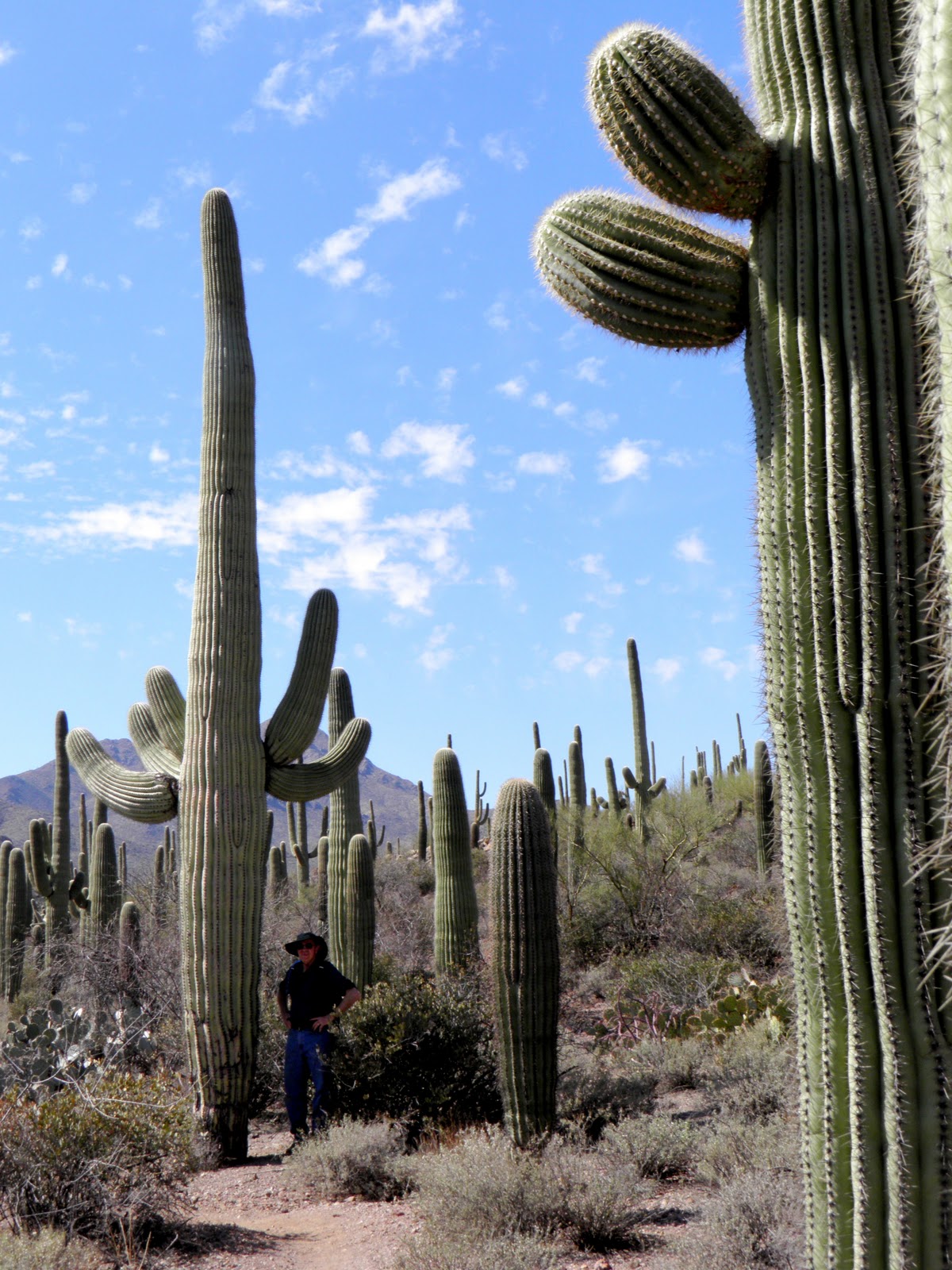
The saguaro cactus, icon of the Sonoran desert
A not atypical sunset out our back door

How Christmas looks when we're in Tucson
These are just a few of the reasons I love Tucson, a place I have lived for ten years this month.  It has brought me many good things, including my loving husband, and is my chosen place on Earth.  It is my spiritual center and my home.

I hope you have a wonderful Christmas and terrific New Year, surrounded by those that mean the most to you and in a place that you love.

Sunday, February 27, 2011

Snow Day

The rare beauty of a cloaking of snow on the Tucson Mountains
With predictions of wind and rain and snow (really?) last night, we went to bed wondering what the morning would bring.  The howling wind and lashing precipitation in the middle of the night coupled with the pacing of our nervous dog made for less than sound sleep until the wind abated before dawn.  Finally things quieted down and I awoke well after dawn to find our nearby Tucson Mountains heavily powdered with snow, a serious rarity around here.

Before noon most of the snow was gone, but the frenzied activity of the birds gave credence to the freeze predicted for tonight.
A male Gila woodpecker topping off at the suet block
A male Costa's hummingbird busy defending this feeder
After the catastrophic freeze a few weeks ago, three nights with temps in the high teens and low 20's, we figure what was going to suffer from serious cold will have already done it and will likely not bother to cover much tonight.  What doesn't survive we'll do without (simplify, simplify, simplify), or replace with plants that can survive temperatures in the mid-teens.

At least we had good weather for a wonderful and long-overdue visit with my daughter and son-in-law recently.  Tucson is like a third home to them, the San Francisco area being their first, so they were not interested in playing tourist every day, though we still got some of that in.  The Desert Museum is always a must, especially when your hosts volunteer there -- one as a docent and the other volunteer with the botany department.  Then we also managed The Cup Cafe at Hotel Congress for breakfast, Tohono Chul Botanic Gardens and lunch at the Tea Room there, and lot and lots of walking the hills of the Tucson Mountains, be they snow covered or not.

Trailside in Sweetwater Preserve, Tucson Mountain foothills
Mother and child reunion hike
In the shade of a saguaro older that
his great-great-grandparents
The early afternoon sleeting has just stopped and once we get past tonight it looks to be highs in the 70s and 80s.  Bring it!

Wednesday, December 1, 2010

The Big Chill

When the weather cools to that perfect high of around 70, we start seeing hot air balloons more frequently, early in the mornings when the atmosphere is cool enough for their warmed balloon interiors to make a difference and provide the essential lift.

Chilly morning hot air ride
Tucson gets about 20 nights of freezing temperatures a year, usually a glancing blow of a few hours just below 32 degrees.  The first one usually occurs right around Thanksgiving, so we were right on schedule.  Problem was, it was predicted to be a hard freeze -- 24 degrees.  It was time to deter the Big Chill.

Out came the styrofoam cups, insulating caps for columnar cacti.  Out came the paper bags, ditto.  Out came the plastic picnic tablecloths with the fuzzy underside (important), old beach towels and coverlets.
We even used a few baseball caps for our larger cactus "heads".


One of my very favorite plants in our backyard is the chuparosa.  It begins flowering in November and flowers all winter long, its tubular orange flowers providing nectar for our year-round Anna's and Costa's hummingbirds along with the nectar robbing mustard headed perpetual motion verdins.  We have a few of these magic winter plants, but my favorite is right outside the dining room window and is the size of a Volkswagen beetle.  I was determined to save this plant from freezing -- it wouldn't kill it but would literally nip it in the bud, likely nixing any more flowers for almost a year.  Several years ago we had a freeze in the high teens and the chuparosa looked like it had been freeze-dried.  We cut it back to medicine ball size in the spring and it bounced back, but I wanted a natural food source for our hummers.

I took every large plastic tablecloth I had, plus some old towels and a bedspread, draped them over the chuparosa and clothes-pinned them together.  We put a trouble light under the cover and kept it lit all night.  It looked like The Blob was having an eerie picnic in the back yard.  Out of appropriate covering, the two rows of green beans we'd been nursing along in our feeble winter vegetable garden would have to fend for themselves.

By night
By day
We saw hummingbirds zipping under the cover at first light, the sugar water in their feeders frozen solid. As I uncovered the chuparosa today, a Costa's hummingbird flashed his royal purple gorget at me, whether in thanks for saving his favorite winter plant or to urge me to get out of the way, I'll never know.

Success!  At least for Round One...
The hummers' food survived.  The green beans -- not so much -- but I can get great ones, cheap, at Costco.  Our flashy hummingbird winter companions?  Priceless.

Sunday, October 3, 2010

Winter Garden

Queen's wreath, tangled in the limbs (and shade) of a palo verde tree
We're not novice gardeners.  For many years we've learned, mostly through trial and error, about what will work in our desert garden and what won't.  We've become increasingly committed to native or desert adapted plants -- plants that work well here and are of use to the local birds and other critters.

A ghostly aloe in the barrio garden
It seems a bit odd to be putting in a winter garden when we were in triple digit heat a few days ago.  Now there's nothing but highs in the 90's in the forecast, and the nights are promised to be blissfully in the lower 60's, so hopefully we've turned a corner.  Still, while our family in Denver are harvesting the last of their crops, we are just beginning.

We always said that if anyplace could drag us permanently away from Tucson it would have to be somewhere that we could do edible gardening in terrific soil with rain that fell from the sky on a regular basis.  But we both love living in the Sonoran desert, especially now that we have a real cabin in the Colorado Rockies to escape to in the summers, so we're not moving.  Ever.  Recently my husband went to a winter gardening class at Plants for the Southwest, one of our favorite nurseries here.  The class was taught by a woman who's been veggie gardening here year 'round for over two decades.  Soil amendments (organic) and knowing what to plant when were the keys.

Pew
Do you know how stinky big bags of steer manure are in the back of an SUV on a hot day?!  Luckily that trip was followed by a trek to get a bale of alfalfa hay which has a lovely grassy smell and left enough of itself behind in the car to freshen up the Honda C-RV.  A dozen packets of seeds, some additional drip irrigation sprinklers, and a "flat free" puncture-less foam filled wheelbarrow wheel and tire to replace the far from "flat free" inner-tube (thorny deserts are hard on them) pretty much completed the necessities for planting our winter garden.

Double digging in the last of the shade
We chose a sunny wall to plant the garden against.  After moving a couple of plumbagos, a Mt. Lemmon daisy, and a salvia, Bob began the double digging process to incorporate these new organics.  This is not an untouched area; we have amended this before.  Deserts are not know for their rich humusy soils, and our yard is no exception.  Developing our vegetable garden's soil will be an ongoing project.

Deep digging and existing drip irrigation systems always clash, but after a lot of digging, a few repairs and additions to the drip system, some raking, with a well-deserved brunch mixed in, we were ready to plant.

Big brunch for hard workers

Ready for seed sowing
By the time we were ready to sow some seeds it near noon and in the high 90's, but we were determined.  In less than an hour we had rows of two kinds of snap beans, snap peas, sweet peas (the flowers), quinoa (our experiment), spinach, two kinds of kale, swiss chard, and garlic.  When it cools off a bit more we'll plant some lettuce mixes and radishes.  Herbs are growing in containers.  Onions will go in after Thanksgiving.  Bob spread a nice layer of sweet smelling alfalfa hay over the bed as a mulch to retain moisture and shade the seedlings.  Eventually it will be dug into the soil for enrichment for next years winter garden.

Just went out to check it...nothing yet.  I guess five hours is a little too soon for germination.

Watch this space

Saturday, July 3, 2010

Hatch Watch

When we got back from Colorado 20 days ago we spotted a female Gambel's quail roosting in one of our flower pots out back.  We don't know when she finished laying her clutch of 10 eggs, but we do know that incubation is between 21 and 24 days, so we can't be too far away from a hatching.

Last night we noticed a male Gambel's quail lurking around the nest.  Suddenly he squatted down on a bare expanse of gravel.  Had he been on dirt we'd have been expecting to see him take a dust bath, but he hugged the stoney ground, looking over toward where the female sat on her eggs under a potted flowering euphorbia.  These quails are monogamous and both take an active role in raising the chicks, but we had to wonder if this was maternity ward waiting room behavior.

It didn't take long to get our answer.  After a couple of minutes the male rose and cautiously approached the pot with the nest and tentatively joined his mate, carefully settling on some of the eggs.  After doing some research we learned that the male incubating the eggs is not unheard of, but quite rare.

You can see the female in the above picture, her shiny eye just above the edge of the pot.  The male is behind her, his black and chestnut head facing the other direction.

I guess we're the ones waiting anxiously in that maternity ward waiting room.

Thursday, July 1, 2010

Sanctuary and Answered Prayers

Shortly after the official start of summer the Sonoran desert is well into its infamous heat, but the notorious dry heat is giving way to a steamier version.   When the weather pattern shifts, usually around the 4th of July, our desiccatingly low to nonexistent humidity gives way to an inflow of tropical moisture, bringing the novelty of clouds, and we wait anxiously for the first rain in months.

We like to help out our tough desert birds by providing fresh water, native food sources though habitat gardening (and the occasional handful of bird seed), shelter, and places to raise their young.  Our efforts are rewarded by the constant presence of some of the most fascinating and adaptive birds in the world.  In the middle of our hottest season we are seeing lots of fledgling birds -- slightly smaller than their parents, frequently seen harassing  them with begging behavior, and not quite as expert in the flying department.  We've had juvenile doves, cactus wrens, thrashers, gila woodpeckers, finches, and even a young pyrrhuloxia seeking the shade of the back porch.


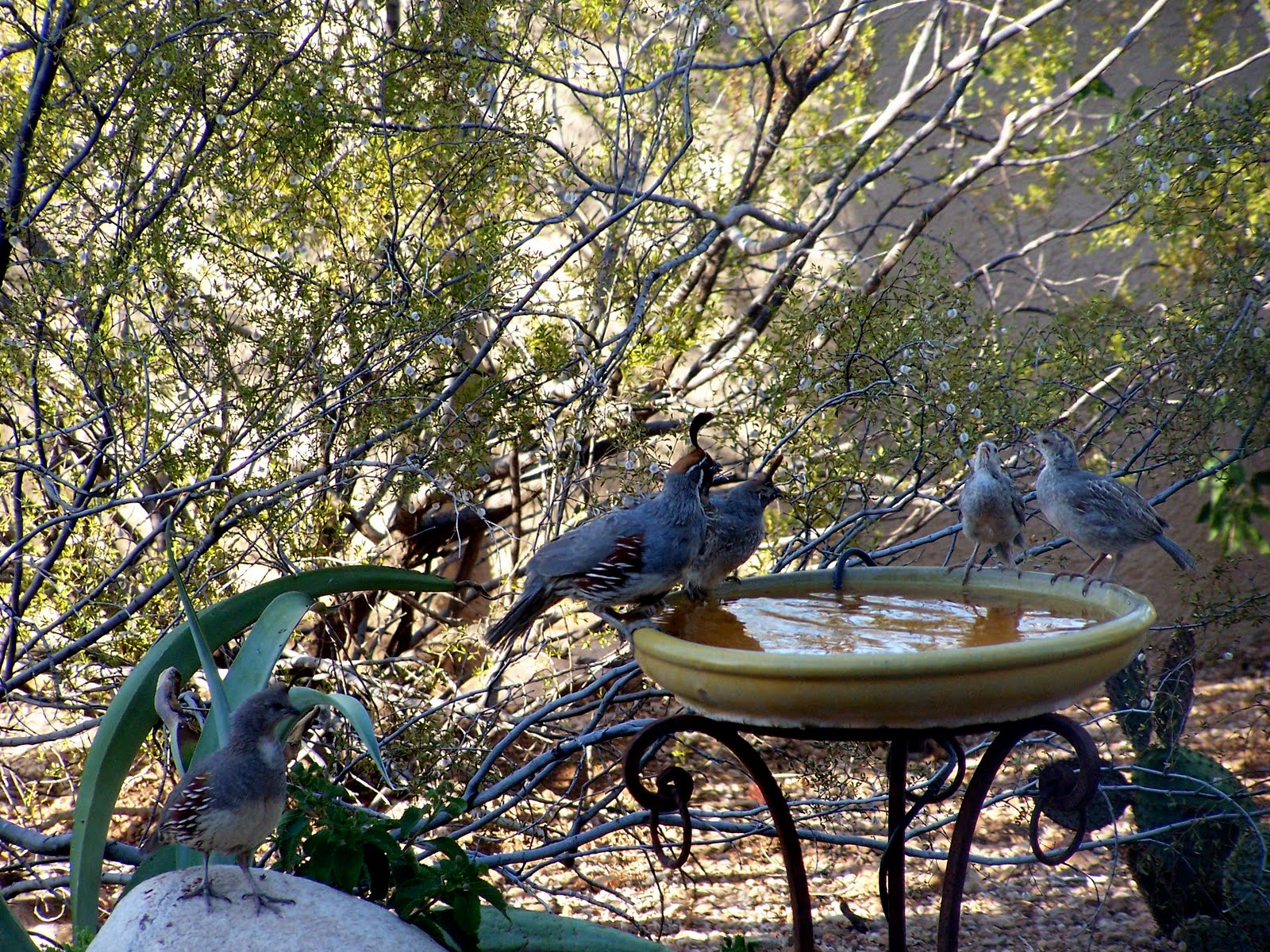
While desert birds have strategies to deal with the long months without rain in a land of little standing ground water, an easy source of water for drinking and bathing is much appreciated.  This early clutch of Gambel quail are being shown the ropes by their parents, visiting the bird bath for a quick early morning drink.

While some quail families are just finishing up their parental duties with their fledglings, others are just beginning, or beginning again.  This clutch of ten eggs is usually hidden by a dedicated female quail, and is due to hatch any time now.  Seeing a string of puffball quail chicks obediently following their mother while papa quail stands guard duty on the garden wall is one of our favorite desert experiences.  A year with abundant (for us) rainfall insures the resources needed to raise more than one family a year, and we are witnessing a banner year for wildlife.

Late this afternoon, bolstered by adequate humidity and triple digit heat, we had our first brief rain of the monsoon.  There is nothing like the first rain after months without, months of searing heat.  The first drops steam off the hot flagstone, and the fragrance of creosote instantly fills the air.  The cool rain on hot parched skin is an exquisite study in contrasts.  And the breaking of the long absence of life-sustaining rain is an answered prayer.


Friday, June 25, 2010

Heat and Prayers


We're back from a month in the Colorado Rockies.  The triple digit heat is a bit of a shock.

When we left in late May it was certainly warming up.  The paloverdes had finally bloomed, making the desert feel as if pale sulfurous yellow clouds had descended to within a few feet of the ground.  The stately saguaros were starting to bloom, satisfying the white winged doves who'd arrived a few weeks before to fulfill one of their purposes in life of moving saguaro pollen from one cupped flower to the next.  The first strings of puff-ball baby quail were being squired through the backyard by their proud and watchful parents.

Our blessedly cool and rainy winter and early spring created a window of opportunity for plentiful reproduction.  Over a month ago we saw our first fledgelings, almost as big as their parents who they chased down and begged for food by trembling their able wings accompanied by nagging cheeps.  Yesterday I was treated to a display of dove love, a mating session in the mesquite outside my kitchen window.  As soon as the brief tryst was over one of the fledglings from the first clutch flew in to join mom, just in case she had something to feed him.  

We are habitat gardeners, but I'll admit to trying to dissuade the doves from nesting in other than natural spots -- in other words, I'd far prefer they use a tree or cactus than my back porch beam or the porch light.  Since the doves build their nests, a loose pile of twigs, in about seven minutes flat, you have to catch them at it.  Well, we got doved.  Yesterday when I walked out the front door to get the mail something near my head exploded.  It was a panicked momma dove vacating her nest, the one she'd built on our porch light.  I got a step-stool to check for eggs and sure enough, there were two, so mama dove gets to stay.  I'll admit it's a sweet spot for her -- shaded and safe from predators other than the winged variety.   We'll hope for a minimum of dove drama -- no naked babies falling from the nest please -- and hope for two healthy chicks that fledge successfully.

In late June we're heading for 110 degrees.  The saguaro are almost done with their blossoms though you see a stray one here or there, and heavily into fruiting.  Green fruits the size of small pears split open, revealing their juicy crimson interiors riddled with tiny black seeds, over 2,000 of them per fruit.  At a time of the year when rain has been non-existent for months, the sweet wet fruit is irresistible to anything that can get to it.  Birds have the easiest time of this while the fruit is on the cacti, but once it falls to the ground it's appreciated by most desert critters.  Birds and other animals, having eaten the fruit, move on and eventually -- through the process of elimination -- disseminate the seeds where one or two, out of millions produced by a saguaro over its long lifetime (which can be well over 200 years), might survive to maturity. 

It's a harsh environment, and one is reminded of that constantly watching the strings of baby quail get shorter by the day.  Near the summer solstice the light is white over the parched landscape.  Plants employ all their strategies -- dropping leaves, dropping whole branches, shriveling to the point of looking as if they'd been in a wildfire -- to survive until the monsoons arrive.  These summer rains the Sonoran desert is so dependent on are born from our searing heat and tropical moisture.  We've had a little pulse of the moisture in the last couple of days, and heat we have in abundance, but not enough moisture to humidify our scorched atmosphere enough to have something left over to wring out.  This is where the praying kicks in -- praying to Mother Nature to give us what we need so badly, the healing release of a hard cooling rain, the hope for survival.  


Sunday, February 7, 2010

Rain is Life

If your religion is the desert, rain is the blessing.  In the desert rain is life.  Pure and simple.

Rain in the desert is a wake your spouse up event.  A go out and stand in it with your face to the sky event.  A time to suck in all the sweet moist smells of the ancient creosote bush that perfumes the air with the falling of the first drops.

Without rain, and enough of it, our Sonoran desert would cease to be what it is, one of the most lush and diverse places on the planet.

No, I did not misuse the word "lush".

Our part of the Sonoran desert has an incredible volume of biomass,  all plants that are adapted to hot and dry, and just as adapted to be opportunists who know how to quickly capture and store any moisture that comes their way.

There is incredible diversity here, both plants and animals, which is due in large part to the two distinct rainfalls we expect each year, rainfall seasons that provide a bridge for surviving a year in the desert.

The monsoons usually start in July and provide most of our average   (in a good year) ten inches of rain; ten inches is the upper limit in the definition of "desert".  These summer rains are tropical in nature and origin, towering cumulus building from the heat of the summer desert.  They fling lightning bolts with careless abandon, their thunder ricochetting off the mountains through the valley, black curtains of rain filling the bone dry arroyos in a matter of minutes.  The indigenous people here, the Tohono O'odham, call these the masculine rains -- sweeping in, suddenly hard and furious, and quickly gone.  Our winter rains, the feminine rain, are in contrast soft and gentle and can last a day or two, their slower pace soaking into the desert floor, nurturing with gentle abundance.

My husband woke me at 4 AM with one word.  Rain.  Five hours later it is still falling steadily from the sky.  I can barely make out the Tucson Mountains that loom a very few miles to our west.  Our backyard creosotes, trunks purple black in the rain, are filling the air with their sharp clean smell.  Our constant and intrepid hummingbirds (they may look cute, but are truly fierce) are zipping through the raindrops; the mourning doves are hunkered down, enduring on the garden wall.

Later, when the rains pass and the sun comes out, the desert will be clean and fresh and sparkling.  More plants and animals will have been assured of the potential of a good year for procreation, and we can look forward to a prolific bloom of our trees, cactus, and perennials, and long strings of baby quail.  A blessing indeed.

Sunday, January 3, 2010

Post-holiday Post

/

There is much to celebrate during the holiday season in the desert.


The temperatures recede, the A/C gets turned off and stays off, and outdoor activities are not governed by avoidance of the heat and sun. Desert sounds of bird calls, coyote serenades, and the breeze whistling through the palo verdes drift in through open windows, day and night. The occasional, too occasional, blessings of winter rains carry the mysterious smell of creosote. While many desert plants shift into idle for a brief rest, chuparosas come into crazy bloom, nourishing our year-round hummingbirds and the mustard headed hyper-active verdin. Javelina come down from the hills and deer visit our yard.  The desert becomes hospitable.

Thanksgiving can be the traditional feast of an herb baked bird with the usual sides, or the turkey can be glazed with chili and served with corn pudding, roasted squash laced with cipotle, and calabacitas, with a pumpkin flan for dessert. Regardless of the menu, it is a convivial holiday that focuses on feasting, family, and friends, and gratitude for life's blessings, especially the fact that perfect temperatures make for excellent hikes that mediate the the effects of indulgent eating.


Christmas is a wonderful blend of American traditions and the prevalent Hispanic cultural influence here in Tucson. No where is more brightly decorated that the barrios, tamales become one of the main food groups, and subtlety goes out the window. Our tree is the top twelve feet of an agave flower stalk, wrapped with colored lights and hung with ornaments collected over decades, a collection we still add to  yearly. Tohono Chul, a wonderful botanic garden in the Catalina foothills, holds Holiday Nights in the park where thousands of white fairy lights illuminate the sprawling mesquites and the paths are lined with luminarias guiding you to music venues and art exhibits. This is the second year I've purchased an artist made and donated ornament, part of a fundraiser for the park. It's a tradition I hope to continue.

The best part of Christmas this year was a visit from my daughter and her husband. We'd seen them twice during the year in their Bay area home, but it was lovely to share the week bracketing Christmas with them in ours. I'd just celebrated the anniversary of my propitious arrival in Tucson eight years ago when my daughter arrived days before Christmas, just like 2001. Their visit was filled with hikes and excursions and good time spent together.

My daughter's one "must do" request was to head south to Tumacacori National Historic Park on Christmas Eve to see the 2000 plus luminarias lighting the old mission. This is a trek we make the evening of December 24th more often than not; it is quite centering in the chaos of Christmas. Visitors' voices hush at the spectacle of soft light on the old walls, allowing the wandering carolers to be heard in the candlelit mission and on surrounding pathways. The mission is located on the sweeping floor of the  Santa Cruz River valley, the Santa Rita mountains curbing the view to the east and were this night silhouetted by a near full moon not yet risen. Visitors gather in the mesquite bosque under trees laden with white lights for homemade cookies and hot chocolate before returning to their own versions of the holiday.


Christmas stockings and a pannetone bread pudding made by my daughter occupied us for a good long while Christmas morning, but the day was too gorgeous to stay inside. A hike was in order and we headed over Gates Pass to Saguaro National Park's King Canyon. This is a familiar hiking spot for us -- in fact we've led hikes up it in our capacity as volunteer rangers for the park -- but it never fails to reveal something new. Cactus, including towering saguaros, cling to the fractured rock walls of the canyon, and each turn up the twisting arroyo provides a new view. There are a few places that require a bit of clambering, but it's an easy challenge and you are well rewarded by petroglyphs over a thousand years old at the upper reaches. We continued on to an old CCC built picnic area with a million dollar view for a brief rest, and then proceeded around to the old Gould Mine, one of the many copper mine shafts (covered) that dot the Tucson Mountains. It was an easy walk along a soft shoulder with a beautiful view of south to Baboquivari and Kitt Peak on our way to the parking lot.


We split up one day, the guys heading to guy things (Titan Missile Museum, the Asarco Copper Mine tour, and Avatar in 3-D) while my daughter and I took a self-guided walking tour of Tucson. We revisited some old favorite places, like Elysian Grove in Barrio Viejo, then a B&B where we stayed on our first visit to Tucson in May of 2001.


The tour included Armory Park and passed the Temple of Music and Art where my daughter became engaged at midnight on New Years Eve in 2003 in the midst of a contra dance celebration. We followed the tour's aqua line through downtown, enjoying the history of some of the buildings and appreciating a few old signs. We wandered the renovated train station, still a functioning Amtrak stop, but also home to trendy restaurants and eateries with great seating indoors or out. We had lunch across the street at The Cup Cafe in the historic Hotel Congress, another tradition of ours. We tried to visit Picante, a favorite shop that specializes in Mexican and other mostly South American imports, but alas, they were shut (we did catch them open a couple of days later). It was a terrific mother-daughter day with lots of old favorites and a few new experiences.

We mostly ate at home -- my daughter and I share an interest in cooking and are good in the kitchen together -- but we had a memorable lunch at Taqueria Pico de Gallo in South Tucson. Their namesake specialty is a large cup of fresh fruit spears -- watermelon, mango, pineapple, coconut, and more -- drizzled with lime juice and sprinkled with salt and chili powder. It sounds odd but is amazingly delicious. Everything they make there is good, but if you go make sure to order at least one taco and choose the soft corn tortillas instead of the flour ones. They are the best I've ever eaten; plump, hand-formed, and fresh off the griddle. This is a Tucson must-do if you like Mexican food, and at the easy end of the cost spectrum with ordering and picking up at the counter and meals on styrofoam plates, but the food is exceptional. If you're looking for a high-end experience, my favorite Mexican food in the world (more central Mexican than border) is Cafe Poca Cosa. If you eat nowhere else, eat there. We missed it this visit, but will catch it the next time my kids are in town.


It was a terrific Christmas, rich with experiences and full of motion, [mostly] healthy eating, and precious time together. And the desert will keep on giving us the best weather in the nation, days in the 70s with chilly nights, for months to come.