Showing posts with label Tucson Mountains. Show all posts

Sunday, February 27, 2011

Snow Day

The rare beauty of a cloaking of snow on the Tucson Mountains
With predictions of wind and rain and snow (really?) last night, we went to bed wondering what the morning would bring.  The howling wind and lashing precipitation in the middle of the night coupled with the pacing of our nervous dog made for less than sound sleep until the wind abated before dawn.  Finally things quieted down and I awoke well after dawn to find our nearby Tucson Mountains heavily powdered with snow, a serious rarity around here.

Before noon most of the snow was gone, but the frenzied activity of the birds gave credence to the freeze predicted for tonight.
A male Gila woodpecker topping off at the suet block
A male Costa's hummingbird busy defending this feeder
After the catastrophic freeze a few weeks ago, three nights with temps in the high teens and low 20's, we figure what was going to suffer from serious cold will have already done it and will likely not bother to cover much tonight.  What doesn't survive we'll do without (simplify, simplify, simplify), or replace with plants that can survive temperatures in the mid-teens.

At least we had good weather for a wonderful and long-overdue visit with my daughter and son-in-law recently.  Tucson is like a third home to them, the San Francisco area being their first, so they were not interested in playing tourist every day, though we still got some of that in.  The Desert Museum is always a must, especially when your hosts volunteer there -- one as a docent and the other volunteer with the botany department.  Then we also managed The Cup Cafe at Hotel Congress for breakfast, Tohono Chul Botanic Gardens and lunch at the Tea Room there, and lot and lots of walking the hills of the Tucson Mountains, be they snow covered or not.

Trailside in Sweetwater Preserve, Tucson Mountain foothills
Mother and child reunion hike
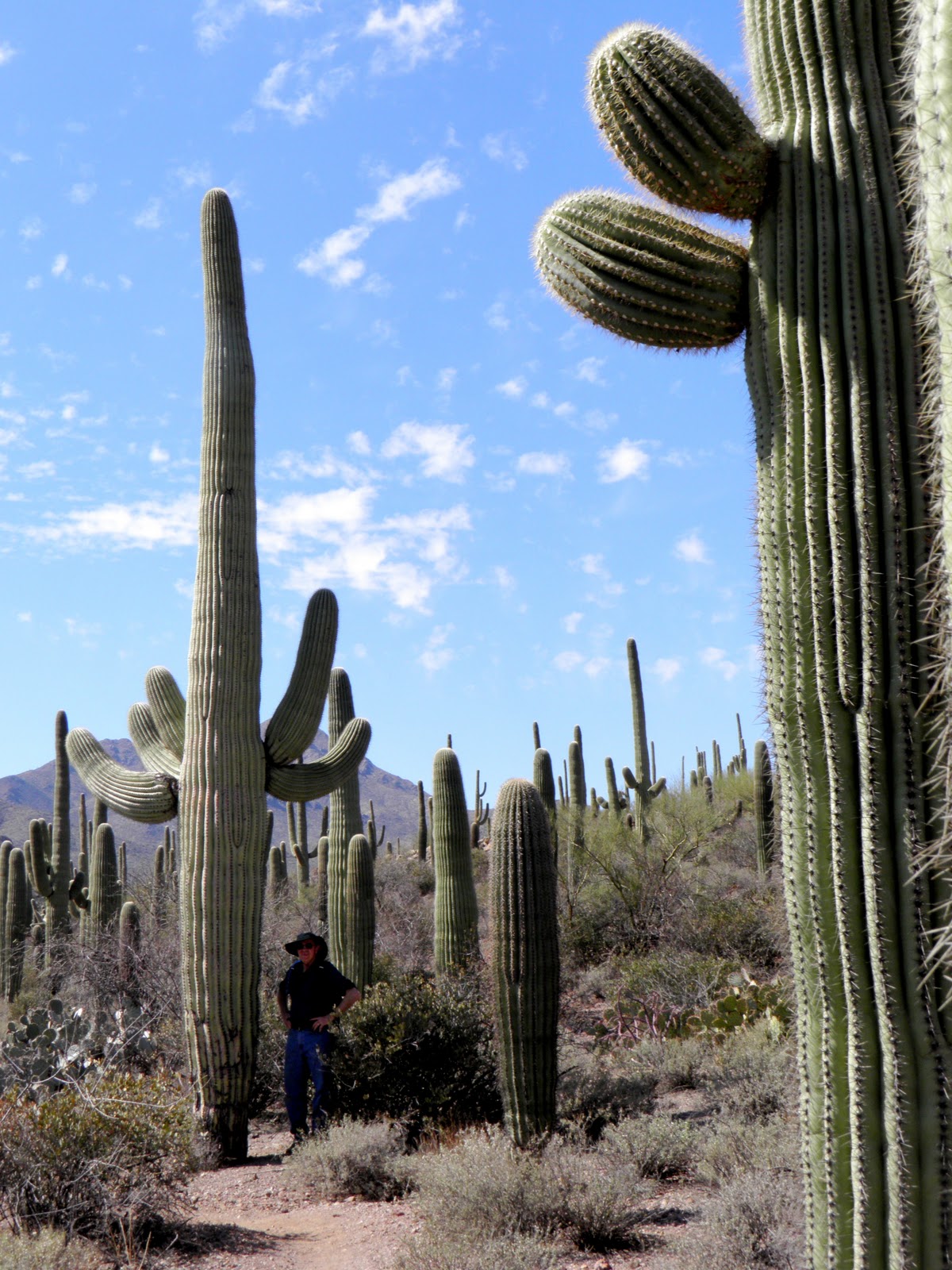
In the shade of a saguaro older that
his great-great-grandparents
The early afternoon sleeting has just stopped and once we get past tonight it looks to be highs in the 70s and 80s.  Bring it!

Saturday, July 3, 2010

Hatch Watch

When we got back from Colorado 20 days ago we spotted a female Gambel's quail roosting in one of our flower pots out back.  We don't know when she finished laying her clutch of 10 eggs, but we do know that incubation is between 21 and 24 days, so we can't be too far away from a hatching.

Last night we noticed a male Gambel's quail lurking around the nest.  Suddenly he squatted down on a bare expanse of gravel.  Had he been on dirt we'd have been expecting to see him take a dust bath, but he hugged the stoney ground, looking over toward where the female sat on her eggs under a potted flowering euphorbia.  These quails are monogamous and both take an active role in raising the chicks, but we had to wonder if this was maternity ward waiting room behavior.

It didn't take long to get our answer.  After a couple of minutes the male rose and cautiously approached the pot with the nest and tentatively joined his mate, carefully settling on some of the eggs.  After doing some research we learned that the male incubating the eggs is not unheard of, but quite rare.

You can see the female in the above picture, her shiny eye just above the edge of the pot.  The male is behind her, his black and chestnut head facing the other direction.

I guess we're the ones waiting anxiously in that maternity ward waiting room.

Sunday, February 7, 2010

Rain is Life

If your religion is the desert, rain is the blessing.  In the desert rain is life.  Pure and simple.

Rain in the desert is a wake your spouse up event.  A go out and stand in it with your face to the sky event.  A time to suck in all the sweet moist smells of the ancient creosote bush that perfumes the air with the falling of the first drops.

Without rain, and enough of it, our Sonoran desert would cease to be what it is, one of the most lush and diverse places on the planet.

No, I did not misuse the word "lush".

Our part of the Sonoran desert has an incredible volume of biomass,  all plants that are adapted to hot and dry, and just as adapted to be opportunists who know how to quickly capture and store any moisture that comes their way.

There is incredible diversity here, both plants and animals, which is due in large part to the two distinct rainfalls we expect each year, rainfall seasons that provide a bridge for surviving a year in the desert.

The monsoons usually start in July and provide most of our average   (in a good year) ten inches of rain; ten inches is the upper limit in the definition of "desert".  These summer rains are tropical in nature and origin, towering cumulus building from the heat of the summer desert.  They fling lightning bolts with careless abandon, their thunder ricochetting off the mountains through the valley, black curtains of rain filling the bone dry arroyos in a matter of minutes.  The indigenous people here, the Tohono O'odham, call these the masculine rains -- sweeping in, suddenly hard and furious, and quickly gone.  Our winter rains, the feminine rain, are in contrast soft and gentle and can last a day or two, their slower pace soaking into the desert floor, nurturing with gentle abundance.

My husband woke me at 4 AM with one word.  Rain.  Five hours later it is still falling steadily from the sky.  I can barely make out the Tucson Mountains that loom a very few miles to our west.  Our backyard creosotes, trunks purple black in the rain, are filling the air with their sharp clean smell.  Our constant and intrepid hummingbirds (they may look cute, but are truly fierce) are zipping through the raindrops; the mourning doves are hunkered down, enduring on the garden wall.

Later, when the rains pass and the sun comes out, the desert will be clean and fresh and sparkling.  More plants and animals will have been assured of the potential of a good year for procreation, and we can look forward to a prolific bloom of our trees, cactus, and perennials, and long strings of baby quail.  A blessing indeed.

Saturday, October 24, 2009

Counting Quail


Next to doves, Gambel’s quail are the most ubiquitous birds in and around our yard, unmistakable with their inquisitive question mark topknots. Their behaviors and social structures cycle dramatically with the seasons. Over the winter they form sizeable coveys, but in late winter and early spring the males begin crowing from prominent heights for mates. Paired up, the couples can be seen walking the garden walls, looking for promising nesting spots. Just about any somewhat sheltered spot will do, from under a dense shrub to a plant pot under my big gardenia in the barrio garden. The later complicates the near daily watering requirements as summer heats up since flushing the mother-to-be off her clutch of a dozen or more eggs too many times can make her abandon the nest. We’ve been known to let a plant or two die in such circumstances.

By late spring we’ve usually seen our first long strings of baby quail in the yard, fuzzy pompoms with legs, only hours or minutes from hatching, obediently following mom and dad’s instructions about vacating the nest in an organized fashion. Over the summer we watch the families’ strings of chicks dwindle. You do not want to be the slowest quail sibling. Still, it is a great victory for the parents to raise a quail chick or two to the juvenile stage. The parents are, after all, only trying to replace themselves in their lifetimes, and the chicks are (sadly) an important food source for other desert critters, from coyotes to snakes to raptors.

The quail have been a bit confused in this time of seasonal transition. In the desert the change from summer to winter mimics a second spring rather than fall. Many plants come into a strong second bloom this time of the year. During those inevitable spells of near 100 degree weather during our cool-down period, the heat spikes trigger a touch of the hormones of spring, and some feeble confused crowing ensues, but it is half-hearted and short lived.

Not known particularly for their flying abilities, quail forage on the ground by day for seeds and insects, flying short distances only when necessary. Shortly after sunset they do manage to fly up into their roosts, trees like paloverde and mesquite and even taller cholla cactus with all their thorns. In our back yard the favorite sleeping spot is in our olive tree, seen on the right in this sunset picture. It is a sterile olive and was here when we moved in, pretty enough and drought resistant, and we enjoy the shade it casts and tolerate it though we’d prefer a native tree in that spot. We think its size, about 20 feet tall, and density appeals to the quail, and there is always an interesting flurry of activity there at dusk.

Shortly after the sun drops behind the Tucson Mountains, we hear the congreating coveys just outside out wall start clucking and whooping, mustering the gang to retire to security off the ground. They chatter and call -- whut Whut, Whut WHUT, whut Whut -- and move more-or-less towards the olive tree, gliding like nuns in habits on an Easter egg hunt.

Tonight we decided to sit quietly where we could see them actually fly into the tree, counting their numbers. One, three, five, nine. Twenty three -- oops, that one fell out after a scuffle -- twenty two. There he goes back, twenty three. The roosting process is accompanied by a great squabbling and beating of wings. It is impossible not to anthropomorphize these birds -- “move over,” “I was here first,” “but I ALWAYS sleep there!” In the space of about ten minutes we counted 32 quail bedding down in our olive tree for the night. Eventually the fussing quieted down to a mumbling murmur. And then it was silent.