Sunday, April 1, 2012

Road Trip

Entering Palm Canyon in Borrego Springs State Park
For the past several years we have been concentrating all our spare time, energy, and money on our Colorado Rocky Mountain property, especially the last three years while we built and set up a summer cabin there.  Now, with the cabin completed and my husband retired we have the time to travel elsewhere.  Recently we took a road trip to mostly old neglected favorite spots, like San Diego, and a few new to us, like Huntington Gardens in Pasadena, and saving the best -- a visit with my daughter and son-in-law in the Bay area -- for last.  Here's a quick survey of some of the highlights of the 12 day sojourn.

Finally...and better late than never!
Crossing over running water in the desert
Our lodging for the trip covered the gamut from camping to a three day stay at a luxury hotel (an Internet steal deal), and we both agreed we liked the camping the best, possibly because of the stellar locations.  First stop on our trek (fueled by lunch at our favorite Yuma eatery, Lute's Casino...which is not a casino) was my old haunt and first desert experience, Anza-Borrego Desert State Park.  Growing up in San Diego, we'd almost always take a day trip on Sundays, and would occasionally make the long drive (especially back in the 1960's) to Borrego.  I had hiked and picnicked in this very area several times as a kid and had made a couple of sentimental journeys back as an adult (one such trip in the late 90's was inspirational enough to play into my moving to Tucson over a decade ago), but I had never camped here, so camping overnight was a long-time fantasy come true.  We hiked up Palm Canyon in the fading light and later watched the huge pumpkin-colored full moon rise across the valley while a small and adorable kangaroo rat performed clean-up duty from our dinner under our camp chairs.  We slept soundly in our little tent and the trip to the bathrooms in the wee hours was pure pleasure and flashlight free under the bright moon by then overhead.

I didn't know he existed 15 years ago...
The trail that led me to Tucson
The next day we were heading to San Diego, but first I wanted to repeat a hike I'd done 15 years before while visiting the area.  The destination was the Pictograph trailhead, and as we drove the five single-track dirt road miles to get there in our Honda CRV, I could hardly believe I'd done it alone all those years before in a rented Dodge Neon.  That trip the desert had brought me to my knees with it's special beauty, and that hike had planted a seed that would later lead to my own transplantation to the Sonoran desert.  It was incredible to hike that trail again and marvel at the life changes it had played a role in...most notably that I was doing it with my husband of seven years who had been my neighbor when I first moved to Tucson.  We've been together ten years next month.  It was a very good move.

Flamingos at the San Diego Zoo

The lath house in Balboa Park

Cafe 222's famous peanut butter &
banana french toast
San Diego had been a favorite getaway before every possible vacation day was dedicated to Colorado.  It had been over five years since we'd been there -- insane considering what an easy drive it is from Tucson.  We stayed at our favorite (only) place, La Pensione in Little Italy, conveniently located on the same block as my favorite restaurant, Filippi's Pizza Grotto, with its funky ambiance, great food, and my over 40 year history eating there.  It had been nine years since we visited the San Diego Zoo, a place I visited frequently when living near Balboa Park back in the 70's, so we decided to take that in, and it's quite a bit to take in.  The following day we found a great breakfast spot, Cafe 222 (highly recommended), and enjoyed a bounteous brunch, the playful decor, and the urban energy.  After a trip on the Coronado ferry we walked some of that meal off by exploring the charming neighborhoods of that near-island town, only to return to San Diego and walk the city harbor front, having an early seafood dinner watching the boats sail by.

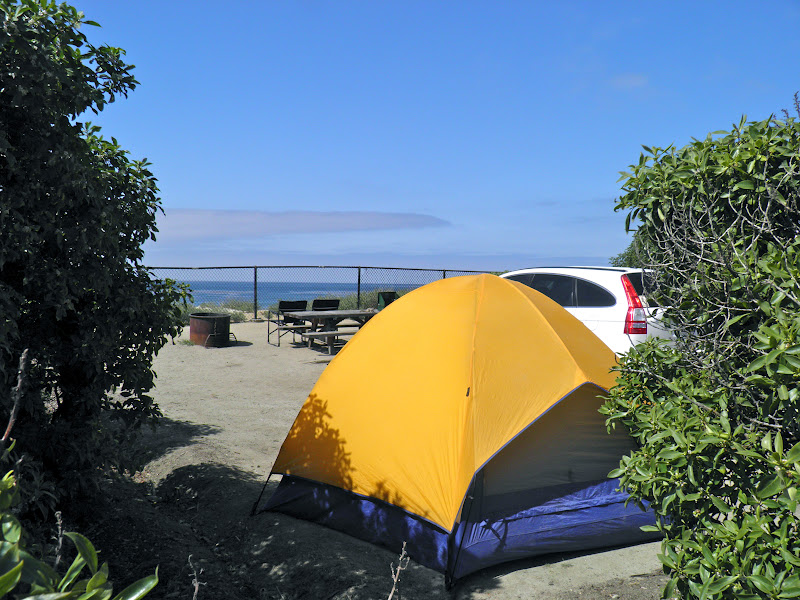
The view from our San Elijo State Beach campsite
I like our tent...
...but am lusting for this!

We had a short driving day leaving San Diego, heading only about 20 miles north to San Elijo State Beach near Encinitas, to our campsite on a bluff overlooking the Pacific.  Seagulls and patrols of pelicans, salt air, surfers, long walks on broad sand beaches, and some of the best fish tacos of our trip from the taco shack in the park, eaten outdoors overlooking the blue Pacific from our wonderful perch.  We spent two wonderful nights sleeping to the sound of the surf, being woken up -- pleasantly -- once in a while by the train going by a quarter mile away on the coastal route.  We fit in a trip to the San Diego Botanic Garden (formerly Quail Gardens) and loved wandering through the eclectic mix of vegetation, proving that coastal San Diego is one of the best growing areas in the world.


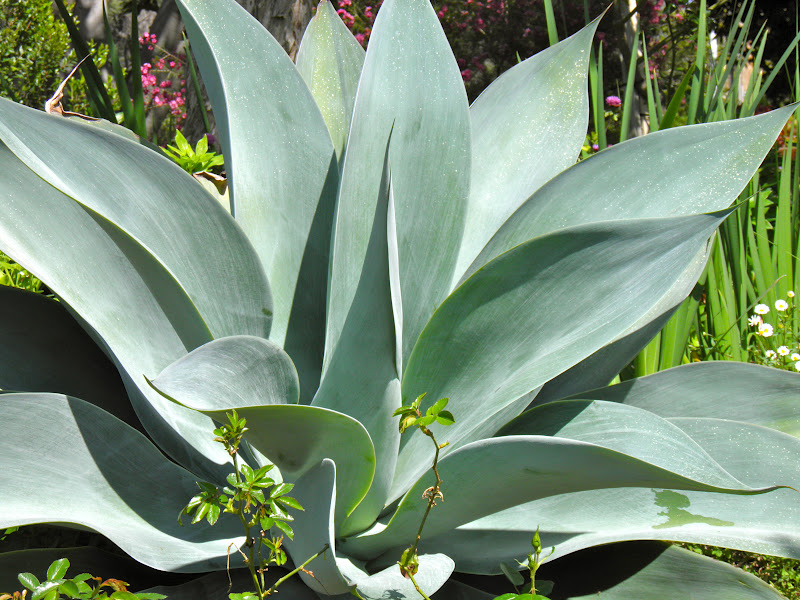
Shades of home in the San Diego Botanic Garden


Chard and red romaine
in the herb gardens


Our next stop was Huntington Gardens in Pasadena, which meant, unfortunately, braving the LA traffic, unpleasant even in off-peak times.  But it was worth it, just, to visit that amazing place.  My favorite spots were the Herb Garden and the Desert Garden (go figure).  For my husband, Bob, an avid desert gardener and volunteer with the botany department at the Arizona-Sonora Desert Museum here in Tucson (where I am a docent), it was a pilgrimage.  Watching the other guests, we found their faces had the greatest sense of wonder in the Desert Garden -- "It's like something out of Alice in Wonderland!" -- and we were not surprised...just pleased.  We spent that night at the home of long time friends of Bob's in the hills of LA.


Bob next to the world's biggest Joshua Tree

Carmel River Inn
The next day we were off north, destination Carmel via Highway 1.  After lunch in San Luis Obispo, where we used to visit my daughter and her husband, we wound our way up the western edge of the continent.  The day was cloudy and threatening rain and we only caught glimpses of ocean from time to time, but it was nonetheless spectacular.  We easily found our next lodging, The Carmel River Inn, a charming collection of cottages in a garden setting (very reasonable and highly recommended).  After wandering the paths and gardens of the property and watching a very vocal Red-shouldered Hawk, we headed over to a nearby wetlands where the best bird sighting was a White-tailed Kite.  Noting the dates and locations of these and some other bird sightings in my Sibley's, we headed out to the historic and very (some might say too) precious downtown area for dinner.  Knowing we didn't want a fussy dress-up restaurant, I'd done some homework and found a place that promised great food, Tommy's Wok.  We were NOT disappointed...best spicy eggplant I've ever had in my life, from a wok so hot it had caramelized the edges of the veggies.  And it was one of the most reasonably priced meals we had on the whole trip.  Don't miss it if you're in Carmel.  My kids were mighty impressed we'd found it as it's some kind of "insiders" secret.  On our way out of Carmel the next morning we stopped at the Carmel Mission on my daughter's advice...and it was good advice.  It's a gorgeous mission with fabulous gardens and the colors of it all were so delicious that it's proven to be one of the most indelible memories of the trip for me.

On the mission grounds in Carmel

One of our favorite exhibits...the jellies
at the Monterey Bay Aquarium
We headed to Monterey Bay and the aquarium the next morning to meet my daughter and her husband.  It was a joyful reunion, especially after not having seen them for just over a year (and that is NOT happening again).  As members of the aquarium, they treated us to our visit there.  It was our second time, the first being nearly eight years ago, and it was just as good the second time around -- better if you consider I got to share it with my daughter.

My daughter Summer
Husband Bob and son-in-law Chris


The next two days were spent cramming in as much together time as my daughter and I could manage.  Our trip, planned long in advance and dictated a bit by when our friend could visit from the Cleveland area and dog-sit for us, wasn't perfect timing for them.  My son-in-law who is working AND going to grad school was cramming for finals and they had just MOVED the weekend before from a nice but tiny apartment in San Carlos to an adorable two bedroom duplex in Mountain View.  My daughter and I explored their new town, took in a movie, shopped for food and prepared meals while one guy studied and the other enjoyed a traveling break for some March Madness hoops watching and a solo (except for Dusty, the dog) sic-fi DVD extravaganza.  The three days went much too fast, and after an Asian food feast in downtown Mountain View (Asian food lovers -- move there!), we had to say our goodbyes.  I WILL be visiting again, and for a bit longer, this summer.

Home sweet home
The next morning I couldn't get out of that overly-extravegant hotel fast enough, and we were in the car and heading south by 6 AM.  It paid off as it was our longest driving day.  Hoping to miss LA traffic altogether didn't pan out as the pass we'd wanted to take was closed due to snow (!), so there we were again, braving the frenzied freeways of the north side of LA, taking the 210 to I-10.  I was so happy to get over the pass and back down into the desert.  We slept in Palm Desert after a wonderful last road trip dinner in Rancho Mirage at Las Casuelas Nuevas, a lovely and graceful Mexican restaurant with none of the tourist trap hysterical decorating that is so discouraging.

The final day, happy to be back in the desert on open highways and looking forward to getting home, we celebrated crossing the Colorado River and returning to our own state, Arizona.  Tucson welcomed us with its lush vegetation, bolstered by a recent rain.  I slept well in my own bed, french doors open to the Sonoran night, the quiet punctuated by coyote calls, and woke to my favorite place on the planet.  It was a great trip, but it was great to get home.


Home again and not bad for the first view of the day!

Sunday, January 8, 2012

On Stewardship and Petunias

The Sonoran desert is a unique environment.  Many think of it as a place filled with things that are too-tough-to-die, a place with incredibly hardy flora and fauna -- wouldn't it have to be? -- and that there's little we could do to impact it. Nothing could be further from the truth.  Every native plant and animal is exactly where it has to be and this challenging environment is exactly what it needs.  If it rained more most of the life in this area of the Sonoran desert, the Arizona Uplands region, would be replaced by other vegetation and critters.
Home, sweet home

Well, except for humans.  We like to move into an area and turn it into our own personal idea of paradise, regardless of how it conflicts with the reality of a place.  It could be that we want our yards to look like they did back on the east coast with manicured lawns, rose bushes, and pest-free vegetable gardens.  Maybe our motivation is our recreation, like golf courses.  Humans seem to want what they want regardless of where they are, and so long as they can afford it, the reality of the environment in which they find themselves, fast disappearing resources and the needs of the native plants and animals fall off their radar.

Worth the cost?
Today we're saying goodbye to an old friend that I've spent a lot of time appreciating from my kitchen window and across my neighbor's fence.  The arms are being amputated one by one.  The body will be sectioned and removed in manageable hunks.  It's probably older than my grandmother's great-grandmother's great-grandmother, and should have lived until my daughter was a much older woman than myself.    In a few hours this stately saguaro, icon of the Sonoran desert, will be gone, apparent victim, in this climate, of the excessive amount of irrigation water required to keep the petunias at its base alive...petunias the appropriate color in the appropriate spot for feng shui garden in one of the most beautiful deserts on the planet.  In a climate where the plants are so good at storing and managing their resources (a hydrated saguaro is about 90% water), too much of what we like to think of as a good thing will kill a plant that is much easier on, and infinitely more critical to, this environment than we humans are.

Symbiotic relationship between the White-winged Dove and the saguaro...
food and a nesting site for pollination services rendered
Phyrrhuloxia at the feast
And so much more than this huge multi-armed saguaro will be lost.  There were probably close to 100 nest cavities in its flesh, providing wonderful safe temperature-regulated places for our desert birds to raise their young.  Gila Woodpeckers and Gilded Flickers excavated every one of those holes, but they were eventually occupied by many different birds as well, from Screech Owls and Pygmy Owls, Purple Martins, Ash-throated Flycatchers and Brown-crested Flycatchers, House Sparrows, and American Kestrels.  Many other birds, from doves to hawks, build nests in the crook of the saguaro's arms.

We felt so lucky to have such a magnificent "bird condo" so close to our yard and loved being part of the extended habitat (birds only care about fences for sitting on).  It is doubtful that our yard will any longer be the flight training ground of the Gila Woodpeckers youngsters, being called between our two younger, and cavity-less, saguaros by their diligent parents.  The screech owl that flew from that saguaro to our mesquite like clockwork every evening just minutes after the sun set behind the Tucson Mountains, coughing up a pellet of indigestibles from last night's hunt, pooping, and having a rouse to realign his feathers before silently flying off in the darkening evening to find dinner will be very missed.  We used to say that he lived next door and we were the outhouse.    

Nectar beyond the pollen is the lure
Of course it's not just about shelter.  That saguaro, with its many arms, bloomed magnificently and with regularity each spring, providing desperately needed nectar in the dryest part of the year for any bird or animal who could get to the blossoms, most importantly bats by night and White-winged Doves by day.  If these primary pollinators were successful, large juicy fruits would ripen a month later, once again providing sustenance to all animals, including humans, who could reach them.  Each fruit, filled with an average of 2,000 seeds, would have these chances at procreation scattered by the birds and mammals that ate them.  Of the four and a half million seeds the average saguaro will produce in its lifetime, it will be lucky to reproduce itself once or twice, though the seeds will not be wasted, but eaten before or after germinating by innumerable insects and animals.

A sad and premature end
Even after falling a saguaro can bloom for another year or two, relying on its store of water and its continued ability to produce energy through photosynthesis.  When the inevitable happens, these huge rotting plants provide food and shelter for millions of insects and many mammals, and return it's nutrients back to the environment.  Except, of course, when they are carted off to the landfill, the sad and wasteful fate of our neighboring saguaro.

I am more aligned with the Native American notion that we don't really "own" land, but are simply temporary stewards of it.  Unfortunately, I have little faith that we humans will recognize what we have before it is gone.  I'll take a saguaro over petunias any day.  And the senior saguaro next door will be greatly missed, though most importantly, perhaps least of all by me.

Goodbye, Old Friend


Monday, December 12, 2011

Back and Gone Again


Old sign in South Tucson
I'm not usually highly distractible, but I must say that the last two and a half years of planning, building, and settling into a summer cabin in the Colorado Rockies certainly has tested me.  It was a great project, and as much as I love the Sonoran desert, a great place to escape the worst of the heat.  Now that the cabin is completed and we've settled in and spent four months in it over the summer, I'd like to think I'm back to my favorite place on earth and ready to give it my full attention, but we are about to head back north to spend Christmas and New Years at the cabin.  One of my resolutions for the coming year is to be wherever I am at the moment FULLY, but for now I wanted to take a little walk down memory lane.

We recently replaced an aged and expiring computer.  When they transferred over our data all my pictures from years ago, prior to my beginning this blog, became wonderfully accessible.  I wanted to share a few of them with you.  They are all reasons I love Tucson and the Sonoran desert.

The wonderful old Barrio Viejo market turned B&B where I used to stay
Some of my Moon Take Night Make Day hikers and part of the
reason I have been a volunteer ranger with Saguaro National Park
for almost ten years
A Virgin of Guadaloupe shrine in Barrio Hollywood
Ancient pictographs along a favorite trail
The screechless Western Screech Owl, a frequent visitor to our yard
The saguaro cactus, icon of the Sonoran desert
A not atypical sunset out our back door

How Christmas looks when we're in Tucson
These are just a few of the reasons I love Tucson, a place I have lived for ten years this month.  It has brought me many good things, including my loving husband, and is my chosen place on Earth.  It is my spiritual center and my home.

I hope you have a wonderful Christmas and terrific New Year, surrounded by those that mean the most to you and in a place that you love.

Tuesday, May 10, 2011

Hoodoo Death March (We Do)


Famous hoodoos of Chiricahua National Monument in southeaster Arizona

We took an overnight camping trip to Chiricahua National Monument over Mother's Day weekend.  We are National Park junkies (and volunteers at Saguaro National Park), and with my husband three weeks from retirement, we thought we'd give ourselves a taste of times to soon come when, at the drop of a hat, we throw our camping stuff in the SUV and take off.  With entrance to the park free thanks to my husband's Access pass (if you are 62 and a US citizen, buy one for $10 and enjoy your National Parks and Monuments free for the rest of your life!), including a half price camp site ($6 a night) thanks to his pass (age does have it's privileges), the price of gas to get there was our only real expense.

Faraway Ranch
We had a lovely and quiet perimeter camping site in Bonita Canyon.  Shortly after pitching tent we made the gentle one and half mile saunter to Faraway Ranch for the Volunteer Ranger led tour of this historic home.  Along the way we encountered white tailed deer and wild turkeys, spotted a Bridled Titmouse, and marveled at the riparian woodlands and meadows.

Still waiting to host guests since the 1960's

This room was originally used as a "fort" for protection from renegade Indians

White-tailed deer in the Silver Spur Meadow
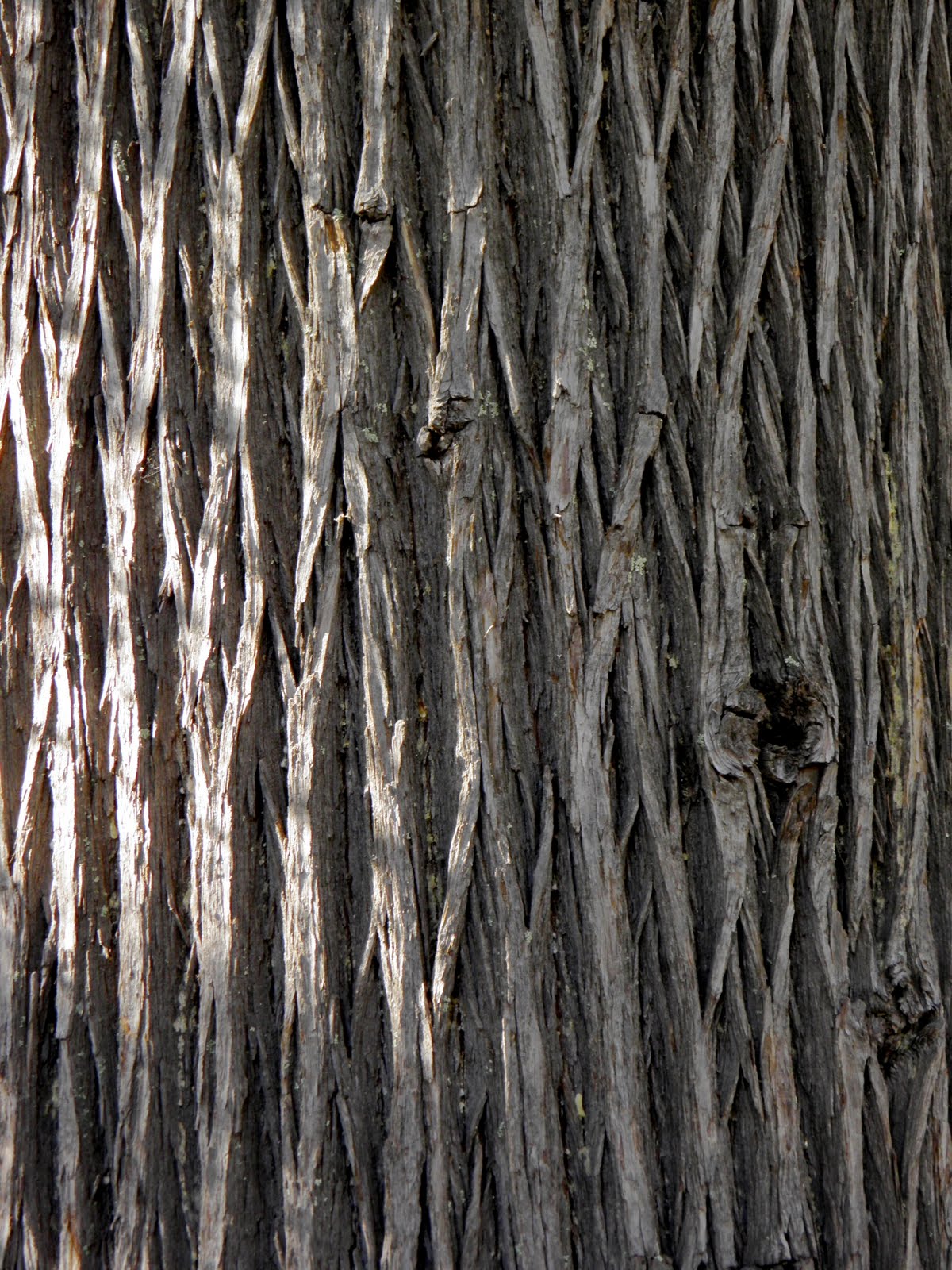
Arizona Cypress bark
Alligator Juniper bark


Amazing trees of the riparian woodlands


That night we slept with a view of the trees, stars, and moon above us through the mesh screen of our tent that sloped over our heads.  The breeze rustled the dried oak leaves nearby and we slept deep.  After an early morning of coffee, oatmeal, and birdwatching (Mexican Jays, Hermit Thrushes, Robins, Yellow-rumped Warblers, Wilson's Warblers, a Hooded Oriole and a boat load of birds I couldn't ID), we de-camped and headed for the Visitor Center where we were registered to catch a ride on the shuttle to the top of the trails that threaded their way through the hoodoos back to the Visitor Center.

Mexican Jays mobbed the campground
When my husband first started talking about the different hikes we could do and mentioned an eight to nine miler he had his eye on, I'd replied "no way".  But after the nice three mile hike the day before and the good night's sleep, I was keen on seeing it all and hiking down the long way round with an additional mile plus loop through the famous Heart of the Rocks side trip.  Sure, it was over seven miles, but most of it was down hill, right?  Wrong.

We had done the Echo Canyon hike down from the top eight years ago [note: that's eight years younger], just over four miles with a 1200 foot descent, and I remember it was gorgeous, downhill, and cold -- it was a Thanksgiving camping trip.  This time we were almost doubling the distance and as we found out within a mile of leaving the top, far from all downhill with extremely rugged trails most of the way, and many of them exposed to the intense May sun.  Over the course of the hike we climbed several hundred feet, much of it over trails with rock "staircases," some with treads of two feet!  The views, when I could look up from the trails (which was not often), were often spectacular, but by mile four of the toughest hiking I've ever done, I was starting to think of the rescue horse, Boomer, that the park service employed. Very high winds with gusts to near 50 mph buffeted us most of the way, blowing grit into our faces and eyes, and making the birding binoculars I lugged a moot point.  While it became a bit of a Hoodoo Death March about half way through our hike, we did see some amazing scenery.

Big Balanced Rock
Duck on a Rock in Heart of Rocks
Take the stairs up...
...and take the stairs down
Pinnacle Balanced Rock
Last look back at the Heart of Rocks
Arizona Mountain Kingsnake...hard to miss
I spotted a Arizona Mountain Kingsnake crossing my path about 3/4's of the way down and took that as a sign.  This snake (I've handled these with my work at the Desert Museum) mimics the markings of the venomous coral snake, so I took it as a sign that the trail was testing me, but would not kill me.  It lightened my mood considerably.  The last half mile was forested and mercifully flat with a smooth pine needle covered dirt trail, the kind we'd hoped we would have encountered much more of over the course of our hike, but hadn't.  Our car sitting in the Visitor Center's parking lot looked mighty good when we finally got there.

We made the two hour drive home elated and exhausted, an interesting combo.  After the use of a considerable amount of hot water we took our achy selves to bed and were asleep before 8:30.  I was surprised to not only find myself able to get out of bed this morning, but feeling pretty darn good.  Maybe our vows not to try anything like that again will go unheeded.  There's a lot of retirement time to come with lots of time to hike in lots of National Parks.  Maybe next we'll go rim to rim in the Grand Canyon.

Well, maybe not next...

Friday, May 6, 2011

Just Another Fabulous Friday at the Desert Museum

A Cactus Wren going for an easy insect meal in a prickly pear cactus flower
Bunny bingeing on primroses
I was assigned to lead the Bird Walk at the Arizona-Sonora Desert Museum today.  These walks are led every morning just as the museum opens, 7:30 AM in the summer.  As I drove into staff parking I passed a woman peering into some bushes in the parking lot, binoculars in hand, and I knew I'd be seeing her soon. Two Canadian couples, unknown to each other, showed up for the bird walk, and yes, one of the women was the one from the parking lot.  We had a laugh about my having ID'd her early on before heading off.  I always preface my bird walks by explaining that while I have a good grasp on the common and obvious birds in this part of the Sonoran Desert -- Gila Woodpeckers, Cactus Wrens, Gambel's Quail, various doves, etc. -- I am not an expert birder, but do know where to take them on the grounds for the best bird watching.  They were fine with that, and then they proceeded to give me the best birding experience ever at the Desert Museum.

Hooded Oriole
We wound our way down to the Desert Garden, pausing at the Pollinator Garden for my first good look at a Green-tailed Towee.  A brilliantly red Cardinal met us at the Desert Garden entrance and then we were off to the races.  Some highlights were the Black-headed Grosbeak, the Ruby-crowned Kinglet, a Bullocks Oriole and a Hooded Oriole, and a Lazuli Bunting.  They were thrilled to spot a Costa's Hummingbird, and we were amused by a Desert Cottontail who couldn't get his fill of primroses.  A Desert Spiny lizard in full breeding colors enticed a mate to join him on the garden wall.

Desert Spiny lizard showing his breeding colors

It worked!  She climbed up to join him on the top of the wall
As we left the Desert Garden we had an excellent view into the high elevation Life Zones area with oak and pine.  It was alive with warblers -- Yellow-rumped, Common Yellowthroat, Wilson's, Townsend's, and a life list bird for one couple, an Olive Warbler.  There was also a beautiful Western Tanager flitting from branch tip to branch tip.  Moving on to the beaver pond in the Riparian Area yielded a Townsend's Warbler and Black-throated Gray Warbler.

Western Tanager feeding 
One of the couples was desperate to see a Gilded Flicker.  I sent them off suggesting they keep their eyes on the holes in the top three or four feet of the saguaros as the Gilded Flickers like the penthouses.  I headed off on the rest of my morning assignments which included interpreting horns and antlers at the Big Horn Sheep exhibit.  They were out and about, grazing on their morning meal, as was a wild Spiny Tailed Iguana, a lizard from much further south in the Sonoran Desert that we have a wild population of on the grounds where water and lush foliage are available.

This Spiny Tailed Iguana exceeded two feet in length
Spotted after this photo op with a lizard tail hanging out of his mouth
Desert Willow blossom
All in all, just another fabulous day as a docent at the Arizona-Sonora Desert Museum.